MOT Advisories Explained
An MOT advisory means your vehicle passed — but a component was flagged as worn or deteriorating. This guide explains every advisory category, what each means, what it costs to fix, and when an advisory becomes a failure.
Quick Answer
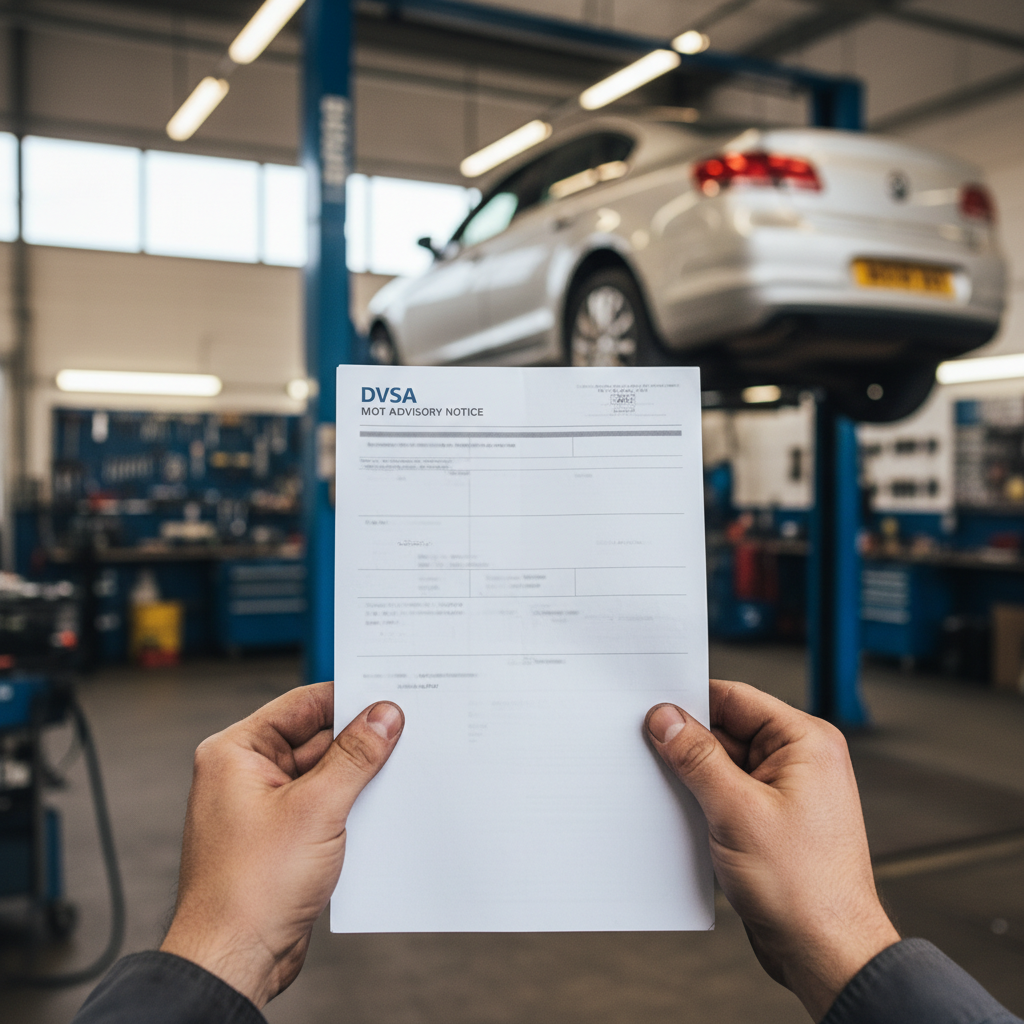
An MOT advisory is an official DVSA record that a component on your vehicle is worn or deteriorating — but has not yet reached failure standard. Your vehicle passes, but the tester documents the issue. You can drive legally, but major advisories should be repaired promptly. Repeated advisories on the same item indicate neglected maintenance and reduce resale value.
What Is an MOT Advisory?
When a DVSA-authorised tester identifies a component that is degrading but has not yet crossed the legal failure threshold, they record it as an advisory on the MOT certificate. The vehicle passes — but the advisory is permanently recorded in the DVSA database and visible to anyone who runs a history check.
Advisories were formally codified in the current three-tier system introduced in May 2018, which replaced the simpler pass/fail/advisory structure. Under the current system, advisories are classified as Minor defects — non-urgent but requiring monitoring and eventual repair.
The key distinction: an advisory today can become a Major failure within 12 months if left unaddressed. DVSA data consistently shows that the majority of brake wear advisories, tyre condition notes, and structural corrosion flags escalate to failures at the next test if not repaired.
| Defect tier | MOT result | Can drive? | What it means |
|---|---|---|---|
| Dangerous | FAIL | ❌ No | Immediate risk to safety — cannot leave test centre |
| Major | FAIL | ⚠️ Risk | Significant defect — repair before driving |
| Minor (Advisory) | PASS | ✓ Yes | Degrading but within limits — monitor and repair soon |
| Pass (no defects) | PASS | ✓ Yes | All components within legal limits |
Common UK MOT Advisories & Repair Costs
Typical UK independent garage repair costs. Main dealer prices may be significantly higher.
| Advisory type | Typical cause | DIY? | Repair cost (UK) | Urgency |
|---|---|---|---|---|
| Brake pad worn | Low pad thickness — still legal but approaching limit | Possible | £80–£200 per axle | High |
| Tyre damage / wear | Tread approaching 1.6mm or sidewall condition | Yes | £70–£180 per tyre | High |
| Oil leak | Failing gasket, worn seals, loose sump plug | Difficult | £80–£400 | Medium-High |
| Coil spring corrosion | Surface rust on spring — structural risk if progressive | No | £150–£400 per spring | Medium |
| Suspension arm / bush | Perished rubber, worn joint — loss of precision | No | £120–£350 per side | Medium |
| Exhaust leak | Failing gasket, corroded joint, crack | Partial | £50–£250 | Medium |
| Headlamp aim | Beam dipped incorrectly — dazzles oncoming traffic | Yes | £0–£50 | Low |
| Windscreen chip | Chip outside Zone A — monitored for crack propagation | Partial | Free–£100 | Low |
In-Depth Advisory Guides
Detailed guides for every major advisory type — causes, DVSA standards, repair costs, and prevention.
Causes, severity levels, repair costs and when it becomes a failure
Read guideHow much wear triggers an advisory vs a failure — and UK replacement costs
Read guideStructural vs surface rust — what's monitored and what costs a fortune to fix
Read guideSidewall condition, perishing, unusual wear — what the tester notes and why
Read guideBlowing gaskets, corroded joints — when an advisory becomes a failure
Read guideWhy headlamps get flagged and whether you can adjust them yourself
Read guideSurface vs active corrosion — what the DVSA tester is looking for
Read guideWorn bushes, perished mounts — what to fix and expected costs
Read guideHow to Use Advisories When Buying a Used Car
MOT advisories are one of the most powerful free tools available to UK used car buyers. Every advisory is an independent, DVSA-certified record of the tester's observations — not the seller's. They cannot be altered or removed.
When reviewing a car's advisory history, look for three patterns: (1) the same advisory appearing on 2 or more consecutive tests — this means the seller ignored official warnings; (2) advisories on safety-critical components (brakes, tyres, suspension) that have not been addressed; (3) advisories that turned into failures — this shows the maintenance trajectory of the vehicle.
Same advisory on 3 consecutive tests = seller ignored 3 official warnings
Advisory on brake pads or tyres present at viewing = negotiate the repair cost off the price
Recurring oil leak advisory = potential engine or gasket issue waiting to worsen
Advisory addressed and no recurrence = evidence of responsible maintenance
Advisory for structural corrosion on older vehicle = commission independent inspection
Check if advisory items are visible during physical inspection — verify the seller's account
Related MOT Guides & Tools
Complete MOT Guide
Everything about UK MOT tests
MOT History Checker
Free DVSA 30-year record
MOT Failures Guide
Every failure category covered
What Fails an MOT
DVSA failure standards explained
Check MOT Status
Current status & expiry date
MOT Advisory Checker
Lookup advisory codes
Used Car Checks
Full pre-purchase check hub
Advisory Check Tool
Read advisories before buying
Pre-MOT Checklist
Prevent advisory failures before your test
The Complete DVSA Defect Classification System
The current MOT defect classification system was introduced in May 2018. It replaced the simpler pass/fail/advisory structure with a four-tier system that gives drivers much more information about the urgency of each defect. Understanding all four tiers is essential when reading your MOT certificate:
| Defect tier | MOT result | Can you drive? | Action required |
|---|---|---|---|
| Dangerous | Fail | No — illegal to drive | Repair immediately; cannot leave test centre |
| Major | Fail | No — must repair before retest | Repair before driving; book retest |
| Minor (Advisory) | Pass | Yes | Repair as soon as possible; monitor |
| Advisory | Pass | Yes | Monitor; repair at next service if needed |
Source: DVSA MOT inspection manual. Every authorised MOT tester uses the same manual and the same thresholds.
Advisories today can become Dangerous defects tomorrow
Advisory Repair Urgency Framework
Not all advisories are equally urgent. Use this framework to prioritise which to fix first:
| Advisory type | Urgency | When to repair | Risk if ignored |
|---|---|---|---|
| Brake pad wear | High | Within 1–2 months | Becomes Major failure; potential Dangerous if pads destroy discs |
| Tyre tread approaching limit | High | Before next test or 3,000 miles | Becomes Major; blow-out risk if sidewall damage develops |
| Oil leak | Medium-High | Within 1–2 months | Engine damage; fire risk if oil reaches hot exhaust |
| Coil spring corrosion | Medium | Within 3–6 months | Spring fracture; suspension collapse |
| Suspension bush wear | Medium | Within 3–6 months | Handling deterioration; becomes Major failure |
| Exhaust leak | Medium | Within 3–6 months | Emissions failure; fumes entering cabin |
| Headlamp aim | Low | Before next test | Dazzles oncoming traffic; becomes Major if too far off |
| Windscreen chip (outside Zone A) | Low | Before it cracks | Can spread; becomes Major if in swept area |
For detailed guides on each advisory type, see our MOT advisory checker and the individual advisory pages linked above.
The MOT Inspection Manual: How Advisories Are Recorded
The DVSA publishes the MOT Inspection Manual — the definitive guide every authorised MOT tester must follow. It defines exactly how each component is tested, what constitutes a pass, a Minor defect, an advisory, a Major failure, or a Dangerous defect. The manual is publicly available on GOV.UK and covers passenger vehicles (Classes 4 and 7).
Why standardised testing matters
When a tester records an advisory, they use specific language from the manual — for example, "Nearside front brake pad worn but not below 1.5mm" or "Offside rear tyre tread approaching minimum." This precise language appears on your MOT certificate and in the DVSA database, visible to anyone who runs a history check.
Advisories as a Buying Tool: The Neglect Indicator
When buying a used car, MOT advisories are one of the most powerful free tools available. They reveal how well the previous owner maintained the vehicle — information the seller won't volunteer. Here's how to use them:
| Advisory pattern | What it tells you | Buying action |
|---|---|---|
| Same advisory on 2+ consecutive tests | Owner ignored official DVSA warnings | Negotiate repair cost off price; investigate root cause |
| Advisory appeared then disappeared next test | Owner fixed it — responsible maintenance | Positive sign; car was cared for |
| Multiple advisories on safety-critical items | Neglected maintenance across the board | Walk away or get independent inspection |
| Advisory on structural corrosion | Potential underlying structural issue | Commission independent inspection before buying |
| No advisories at all on a 5+ year old car | Either very well maintained or recently repaired | Verify with physical inspection and service history |
The 30-second used car check
Sources: DVSA MOT inspection manual (defect classification and advisory standards); DVSA MOT history service; Road Traffic Act 1988. Always verify critical information directly with the relevant official source.
MOT Advisory FAQs
Ste Robinson
Founder, MotR · Last reviewed 14 June 2026
Ste Robinson is the founder of MotR, helping UK drivers check MOT history, tax status, vehicle records and ownership information using official DVLA and DVSA data.
Check Your MOT Advisories — Free
Every advisory from every past test — official DVSA records in 30 seconds. No signup required.